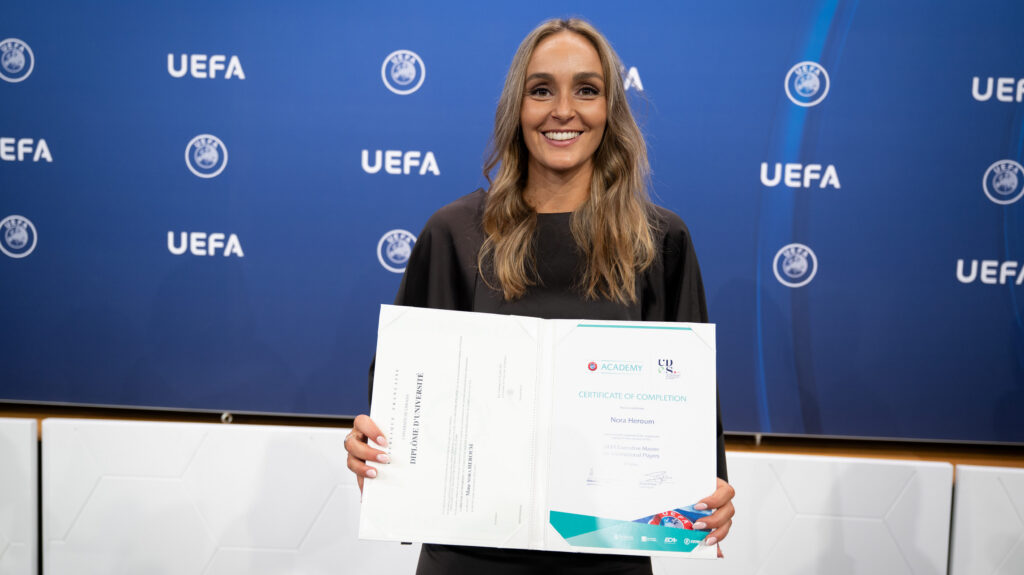
A Finland international with 93 caps, experienced European professional and recent UEFA MIP graduate, Nora Heroum has combined a successful playing career with a commitment to education. Having represented her country at three UEFA Women’s EURO tournaments and played professionally across Europe, she is now preparing for the next chapter, with ambitions to help shape the future of women’s football beyond her playing days.
How has women’s football changed since you began your professional career?
It has changed massively. When I went abroad, there was no guarantee that I could make it because there weren’t so many opportunities and there was no money involved. You couldn’t see the games on TV, so girls now being able to see us play is one of the most important things. When I was young, I only saw boys, so all my favourite players were men. Now it’s nice that young girls can see us and have role models within the women’s game.
Even the marketing, partnerships and communications have moved forward massively. All aspects of the game have developed. I always trusted that it would change and thought, okay, maybe I can make it.
Looking back on your career so far, what are the moments you’re most proud of?
I always dreamed about playing professionally and representing my national team, so definitely those two. My dreams came true. I got to play 93 games for Finland, represent my country at three UEFA Women’s EURO tournaments and play at the FIFA Under-20 Women’s World Cup.
Then there is playing abroad in Italy, England and Denmark, as well as the titles I won.
Although I think what is best is the people, the experiences and everything you gain from the journey. Being part of the growth of the women’s game has been one of the most rewarding things. When you see young girls in the stands wearing your shirt, asking for a picture or wanting an autograph, you realise the impact you can have. Being able to be a role model is what I find most rewarding.
What qualities do you think are most important for succeeding as a midfielder at the highest level?
Of course, technical and physical skills are important, but you also need to be able to read the game quickly and stay one step ahead of your opponent.
So definitely football intelligence and understanding the game, but also mental toughness, dedication and the drive to keep pushing yourself to become the best version of yourself.
What motivated you to pursue the MIP course while continuing your football career?
I have always studied. I completed a bachelor’s degree in Sport Management and then wanted to continue with a master’s degree.
I completed an internship with the Finnish Football Association and heard about MIP through Hannu Tihinen, another Finnish former player who completed the programme. He told me that I had to apply.
Then I saw that Verónica Boquete had completed MIP while still playing professionally, so I asked her how she managed it. After that, I decided I would do everything I could to make it happen while continuing my playing career. I wanted to continue my studies and prepare myself for the next chapter of my life. Hannu and Vero were both huge inspirations.
Were there moments when balancing coursework, travel, training and matches felt overwhelming? How did you manage that?
Yes, sometimes it was tough. During that time I was still playing for the national team, travelling internationally and completing MIP.
Looking back now, I sometimes wonder how I managed it. But I was always excited for the next session. I enjoyed it so much.
When I applied, I knew it was going to be a challenge, so I prepared myself for that. Because I enjoyed it so much, it actually gave me energy.
What advice would you give to young footballers who want to pursue higher education while competing at an elite level?
Organise yourself.
The first session was tough because I didn’t yet have a routine. Whenever I felt support from my club, it became much easier to manage everything, so I would definitely advise communicating clearly with your club and helping them understand what the commitment involves.
What skills from football translated most effectively into the classroom environment?
Leadership, for sure. Also, being able to work as part of a team with people from different cultures and backgrounds, and all of the communication skills that come with that.
Football also teaches you how to work towards a goal. As athletes, we are used to setting targets and doing everything we can to achieve them. That mindset translates directly into studying and working life.
You’ve shown that it’s possible to pursue both elite sport and higher education. What message would you like to share with young athletes who feel they have to choose between the two?
I don’t think you need to choose. It depends on your personality and what works best for you. I’m very active and like doing many things at the same time, but some people prefer to focus on one thing.
You need to know yourself, but it is definitely possible. There’s no rush with your studies and you can do them at your own pace. There are also so many opportunities to study online now, which is great for athletes.
For me, it helped create balance in my life. Football was my main focus, but having my studies as well was important for my mental wellbeing and gave me something else to focus on.
Have you thought about life after playing professionally yet? Do you feel prepared for that next chapter?
Definitely.
I know I want to do something within women’s football and help it continue to grow. I think former players can give so much back to the game because we have lived those experiences ourselves.
The women’s game is growing rapidly, but there is still huge potential. To reach those bigger goals, we need former players involved in shaping the future of the sport and bringing their experience into boardrooms and leadership positions.
I hope many of us stay involved in the game after our playing careers because we still have so much to contribute.